
Vase shapes for flower arrangements: matching flowers to the right vase
Why the same bunch stands tall in one vase and flops in another, and what to do about it: matching bud vases, cylinders, bottles and wide bowls to your flowers, the 1.5 to 2 times height guideline, simple fresh-flower care, styling artificial flowers and reading Lasaki vase sizes in cm.
Lasaki Ceramics team11 min read
Product details checked 28 October 2026

In this guide
- Look at the opening first
- Vase shapes and what they do best
- The proportion guideline: 1.5 to 2 times the vase height
- Fresh flowers: making them last
- Artificial and dried flowers
- Choosing from the Lasaki vase range
- Styling ideas for homes, cafés and shops
- Common mistakes and quick fixes
- For florists, cafés, hotels and interior designers
A bunch of rajnigandha (tuberose) that stands tall and graceful in one vase can slump to one side in another. A single rose can look lost in a big vase and just right in a small one. The flowers are the same; the vase is different. Its height decides how long the stems should be, and the width of its opening decides whether they stand upright or fan out.
Look at the opening first
Check three things, in this order:
- The opening. A narrow mouth keeps stems close together and upright; a wide one lets them lean out, so it needs more stems or some support.
- The height. This sets how long the stems should be (see the guideline below).
- The base. A light, narrow vase can tip over under a heavy bunch, especially on a busy café table.
Vase shapes and what they do best
| Shape | What it does | Good with | Watch out for |
|---|---|---|---|
| Bud vase: small, with a narrow mouth | Holds one to three stems upright | A single rose, a gerbera, a sprig of leaves | Holds very little water; top it up daily |
| Cylinder: straight sides | Lets long, straight stems stand together | Rajnigandha spikes, gladioli, a tight bunch of roses | A wide one needs plenty of stems, or the bunch leans |
| Bottle: a slim neck | Holds one or a few long stems or branches | One long stem, a leafy branch, money plant cuttings, dried grass | Hard to clean inside; use a bottle brush |
| Wide-mouthed vase or urn | Lets flowers spread into a full, rounded bunch | Mixed bouquets, chrysanthemums (guldaudi), roses | Stems slide to the edges unless you add support |
| Low, wide bowl (urli) | Shows flower heads floating on water | Genda (marigold) heads, rose heads, short-stemmed flowers | Only the heads show, so use fresh, fully open blooms |
| Flat vase: thin from front to back | Shows a few stems in a line, like a picture | Two or three slim stems, a single flower, small leaves | Holds little water; check it daily |
Money plant (pothos) vines root easily in water; cuttings in a bottle are a familiar sight on Indian windowsills. Keep the leaves out of the water and change it when it looks murky. If you have cats or dogs, keep money plant cuttings and vases of chrysanthemums, carnations or gladioli out of their reach: the ASPCA, a US animal-welfare organisation, lists all of them as toxic to cats and dogs.
Holding stems in place in a wide opening
- Tape grid. While the vase is still dry, stick clear tape across the rim in both directions to make small squares, then fill it and push a stem or two through each square.
- Pin holder (kenzan) or chicken wire. A pin holder, used in Japanese ikebana, is a heavy base of upright pins that grips each stem; the vase must be wide and flat enough inside to take it. A loose ball of chicken wire holds heavy stems well.
- Greenery first. Put in a few leafy stems before the flowers; they cross inside the vase and give the flowers something to lean on.
Cover whatever you use with leaves or flowers so it does not show.
The proportion guideline: 1.5 to 2 times the vase height
One common guideline, from a floral arrangement lesson on the UGC's e-PG Pathshala platform, is that the arrangement should stand about one and a half to two times as tall as the vase, closer to twice for a tall vase. Some guides, such as Brooklyn Botanic Garden's, treat 1.5 times as the upper limit, so start there and go taller only in a tall, steady vase.
Stems rest near the bottom of the vase, so the length you cut is roughly the final height: for a vase about 20 cm tall, cut stems of about 30 to 40 cm.
- Hold a stem against the outside of the vase and slide it up or down until the flower sits where you like it: about 1.5 times the vase height for a compact look, nearer 2 times for a taller, airier one.
- Cut it where it lines up with the bottom of the vase.
- Use it to measure the rest, cutting a few slightly shorter so the flowers sit at different levels, not in one flat line.
The three Evelyn sizes show how quickly the numbers change (product data):
- Evelyn small, about 15.5 cm tall: flowers about 23 to 31 cm
- Evelyn medium, about 20.5 cm tall: flowers about 31 to 41 cm
- Evelyn big, about 26.5 cm tall: flowers about 40 to 53 cm


When to bend the guideline:
- Dining tables: keep flowers low enough for people to see each other.
- Low, wide containers: build outwards as well as upwards.
- Slim, light vases: long stems make them top-heavy; stay near 1.5 times the height, or add a few clean pebbles for weight.
Fresh flowers: making them last
Gardening guides from two US universities, Penn State and the University of Florida, give much the same routine:
- Start with a clean vase. Wash it in hot, soapy water and rinse it well.
- Add flower food. If your bouquet came with a sachet of flower food (a powder or liquid that you mix into the water to help cut flowers last), mix it in as directed; you can also buy it separately, from some florists or online. Commercial flower food works better than home-made mixtures.
- Strip the lower leaves. Leaves under water rot and cloud it, so remove them; leave the upper leaves, which help draw water up the stem. The guides differ on rose thorns: Penn State suggests removing any that would sit under water, while the University of Florida warns that removing thorns wounds the stem and lets microbes in. If you take any off, remove only those below the waterline.
- Recut the stems. Take about 2.5 cm (an inch) off each stem at an angle with a sharp, clean knife or secateurs that will not crush it, under water if you can, and put the stems in quickly.
- Choose a cool spot. Keep the vase out of direct sun, away from heat (a sunny window, the stove, warm appliances) and away from the fruit bowl: ripening fruit gives off ethylene gas, which makes flowers age faster.
- Keep an eye on it. Top up the water daily. Every few days, or as soon as it turns cloudy, empty and rinse the vase, add fresh water and flower food, and recut the stems.
Flowers in Indian weather
- In the hottest months (April to June in much of India), keep flowers in the coolest spot, away from afternoon sun, and check small vases daily, as they run low fast.
- Tamil Nadu Agricultural University's horticulture notes describe rajnigandha as an excellent cut flower for table decoration; its long, straight spikes suit tall cylinders and bottles.
- Penn State Extension lists chrysanthemums, carnations, sunflowers and zinnias among the flowers known for a long vase life.
- Genda is used mostly as loose flowers for decoration and puja; float the heads in an urli and you need no stems at all.
Artificial and dried flowers
Lasaki does not sell artificial flowers. With artificial or dried flowers and grasses, the same proportion guideline works, and a few things get easier:
- No water needed, so flat or very slim vases, and vases not made for water, all become options.
- Cut wired stems with wire cutters, since many artificial stems have wire inside, then bend each one slightly so the bunch does not look stiff.
- Hold them in place with dry floral foam, or fill a wide vase with crumpled paper, sand or pebbles for weight, hidden under a little dried moss.
- Dust them with a soft, dry paintbrush, weekly in a shop or café.
Choosing from the Lasaki vase range
Most vases in the Lasaki Flower Vases range are about 12.5 to 34 cm tall (product data). When you read the listings:
- Small, Medium and Big compare sizes within one design only. Evelyn small is about 15.5 cm tall; Arin, with no size label, is about 31 cm.
- Each round vase has one diameter figure, and the data does not say whether it is the opening or the widest part, so check the neck in the photos.
- Donut vases are listed by length, width and height, and are only about 3.5 to 6 cm from front to back, so they are flat. Their inch figure is close to both the height and the length: Donut 5 inch is about 13 cm tall and 13 cm long, Donut 10 inch about 26.5 cm tall and 24.5 cm long.
| Vase | Size (product data) | Flowers at 1.5 to 2 times | What the numbers suggest |
|---|---|---|---|
| Half Moon cream | about 12.5 cm high, 15.5 cm long, 6 cm front to back | about 19 to 25 cm | One of the shortest in the range: short stems for a dining or café table |
| Ayla small vase antique | about 13 cm high, 6.5 cm wide | about 20 to 26 cm | Bud-vase size: one to three stems |
| Finlay small white | about 16 cm high, 4.5 cm wide | about 24 to 32 cm | Very slim: one or two stems |
| Voltra white | about 16.5 cm high, 11 cm wide | about 25 to 33 cm | The largest listed diameter for its height: a short, full bunch |
| Donut vase 6 inch mint | about 16.5 cm high, 15 cm long, 4.5 cm front to back | about 25 to 33 cm | Flat; check the photos for the opening: one or a few slim stems |
| Apsara big white | about 25 cm high, 14 cm wide | about 38 to 50 cm | One of the largest listed diameters: a fuller bunch of long stems |
| Arin brown mughal vase | about 31 cm high, 10 cm wide | about 47 to 62 cm | Tall: rajnigandha spikes, long stems or branches |
| Finch big cream | about 34 cm high, 11.5 cm wide | about 51 to 68 cm | The tallest in the range: long branches or a statement bunch |


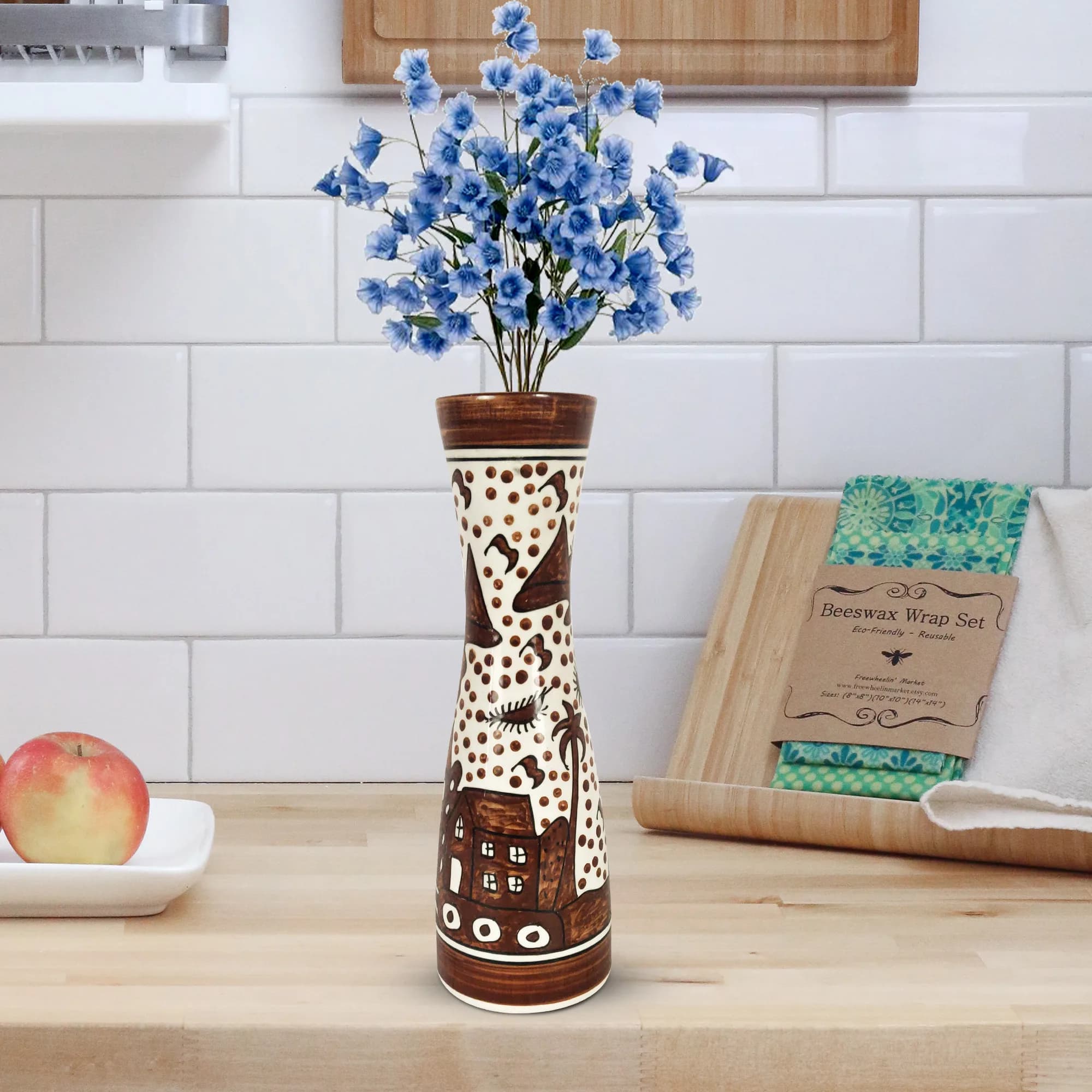
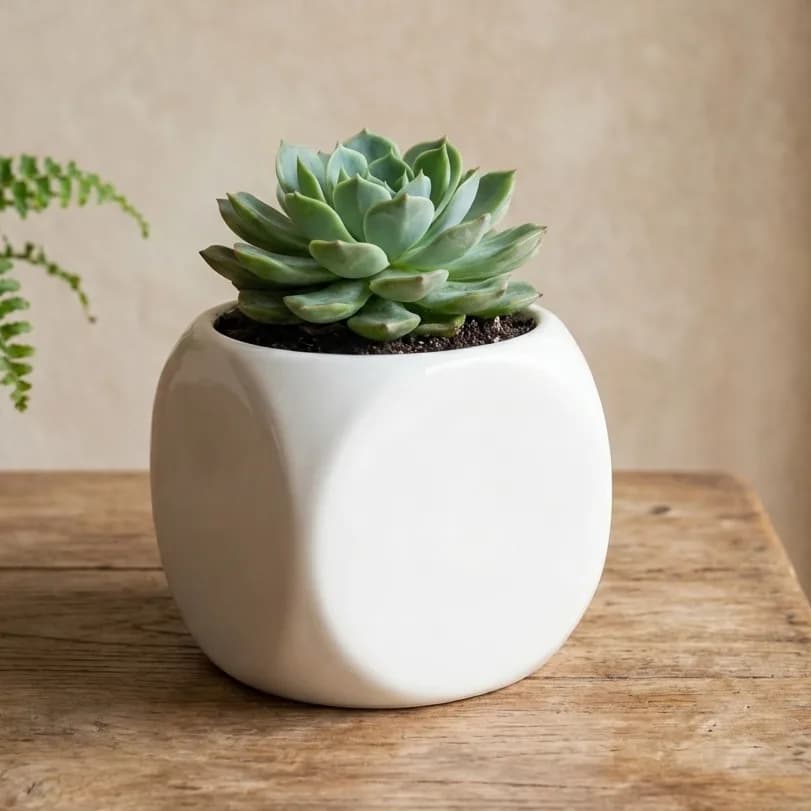
Most designs come in several colours: Evelyn and Apsara each have 15 colour options. Browse the whole range, with heights and widths in cm, under flower vases.
Styling ideas for homes, cafés and shops
- Group in threes. Three vases of different heights in one colour look planned rather than crowded; Evelyn's three sizes make this easy, with the tallest at the back.
- Repeat along a table or counter. A row of small vases with a stem or two each often beats one big bunch and is easier to refresh; on a café table, one stem leaves room for plates and cups.
- Entrances and reception desks. A tall vase of long stems or branches greets people first; place it where nobody will brush against it.
White vases suit almost any flower colour and are easy to repeat across a café, hotel or shop. See them all under white vases.
Common mistakes and quick fixes
| Problem | Likely cause | Fix |
|---|---|---|
| Flowers sink into the vase | Stems too short for it | Use a shorter vase, or cut all the stems down for a bud vase |
| Stems fall to the sides | Too few stems for a wide opening | Add more stems or greenery, or a tape grid |
| The vase tips over | Long stems in a light or slim vase | Shorten them towards 1.5 times the vase height, or add pebbles |
| A damp ring on the table | The vase may not be made to hold water | Use a liner and a mat, and ask us about that vase |
For florists, cafés, hotels and interior designers
Each Lasaki vase listing gives the height and width in centimetres, so you can plan stem lengths before you order. Retailers, florists, cafés, hotels and interior designers can request trade access to order from the catalogue. For anything a listing does not answer, such as whether a vase is made to hold water, ask us.
Frequently asked questions
How tall should the flowers be compared with the vase?
A common guideline is one and a half to two times the vase's height. Start near one and a half times and go towards twice only in a tall, steady vase. With a 20 cm vase, that means stems of roughly 30 to 40 cm, since they rest near the bottom. Keep them lower on a dining table so people can see each other.
What kind of vase suits a single flower?
A small vase with a narrow mouth, often called a bud vase, holds one stem upright instead of letting it lean against the rim. In the Lasaki range, Ayla small (about 13 cm tall) and Finlay small (about 16 cm tall and 4.5 cm wide) are around that size, according to the product data. Look at the product photos to see the shape of the neck.
How often should I change the water in a vase?
Look at it every day and top it up. Every few days, pour it all out, rinse the vase, refill it with fresh water and flower food, and trim the stems again. If the water turns cloudy sooner, change it straight away. Small vases hold so little that they can run low within a day in hot weather.
Can I put water in a Lasaki vase?
Our product data does not yet say which vases are made to hold water. Check the product photos or ask us about the vase you have in mind. If you are not sure, put a glass jar or plastic bottle inside it as a liner for fresh flowers, or use the vase for artificial or dried flowers.
Does Lasaki sell fresh or artificial flowers?
No. Lasaki supplies vases, pots and other décor, but not fresh, dried or artificial flowers. Retailers, florists, cafés and interior designers who want vases for their own flowers can request trade access to the catalogue.
How do I stop flowers falling to the sides of a wide vase?
Give the stems something to hold on to. A criss-cross grid of clear tape across the opening (stick it on before you add water), a pin holder, or a loose ball of chicken wire inside the vase all work. Starting with some leafy greenery helps too, and more stems in total will fill the opening better.
Products in this guide


Stock Lasaki pots, vases and décor in your store
Retailers, nurseries, cafés and interior designers order from the full Lasaki catalogue with a trade account.
Share this guide
Share on WhatsApp

