Pot plates and trays: how to pick one that fits
A plate under a pot keeps floors clean and makes watering easier, but only if it fits and never holds water for long. How to measure the pot base, choose between plates and trays, water from below and keep saucers mosquito-free in the monsoon.
Lasaki Ceramics team11 min read
Product details checked 28 October 2026
In this guide
- What a plate under a pot is for
- The one rule: don't leave the pot standing in water
- How to measure a pot so the plate fits
- Plate or tray: which shape suits your pot?
- Pots that come with their own plate
- Watering from below with a plate or tray
- Styling a group of pots on a tray
- Common mistakes and quick fixes
- Checklist before you choose
- For shops, nurseries, cafés and designers
A plate under a pot is easy to forget until something goes wrong: a ring on the floor, a muddy streak along the windowsill, or water dripping off your balcony onto the flat below. Used well, a plate or tray keeps the house clean and makes watering easier. Left full of water, it keeps roots soggy and gives mosquitoes somewhere to breed.
This guide covers what a plate does, how to measure a pot so the plate fits, when a tray beats a round plate, and how to group pots on a tray so they look planned rather than parked.
What a plate under a pot is for
When you water a pot that has a drainage hole, the extra water runs out of the bottom, often carrying a little soil with it. A plate (also called a saucer or drip plate) catches it, which brings three benefits:
- Clean floors and furniture. No puddles on marble or tiles, no muddy marks on a wooden shelf or a windowsill. On polished wood, a coaster or waterproof mat under the plate adds extra protection.
- No drips on the flat below. Water from your balcony pots stays on your balcony.
- Easier moving. A tray turns three or four small pots into one unit you can lift, clean under or turn towards the light.
A plate only has work to do if water actually comes out of the pot. If a pot has no drainage hole, the plate stays dry and the extra water collects inside the pot instead, around the roots. Our product listings don't say which pots have a hole, so for any Lasaki pot, check the product photos or ask us.
The one rule: don't leave the pot standing in water
A plate is a place for water to land, not a place for it to stay. Colorado State University (CSU) Extension puts it plainly: most plants don't tolerate waterlogged soil, so they shouldn't stand in water, and whatever collects in the tray should be thrown away once the soil is moist. University of Illinois Extension adds why drainage matters: water that drains freely leaves enough air in the soil for the roots. So when the bottom of the pot sits in a pool, the soil stays wet and the roots go short of air.
A simple habit takes care of it:
- Water until a little runs out of the bottom.
- Wait until the pot stops dripping.
- Tip the plate out. For a heavy pot you can't lift, soak the water up with a sponge or an old cloth.
Monsoon, saucers and mosquitoes
Standing water in a plate isn't only a problem for the plant. The Aedes mosquitoes that spread dengue lay their eggs in containers that hold water, and the US Centers for Disease Control and Prevention (CDC) names flowerpots, vases and saucers among them. Its advice is to empty and scrub flowerpot saucers once a week, indoors and outdoors, to remove eggs and larvae. The World Health Organization likewise advises covering, emptying and cleaning household water-storage containers every week.
That matters most during the monsoon, when rain keeps refilling the plates under balcony and terrace pots:
- After each spell of rain, go round and tip out every plate.
- For pots that stand fully in the open, consider taking the plates away for the rainy months and putting them back when the rains are over.
- Once a week, give each plate a proper scrub, not just a tip.
- Follow any advice issued by your municipal corporation or local health department.
How to measure a pot so the plate fits
There is no universal chart that says "this pot needs that plate", because pots sold under the same size can have very different bases. The reliable method is a measuring tape and two minutes.
- Measure the base, not the top. Lift the pot or tilt it on its side and measure straight across the flat bottom, the part that touches the floor. Many pots are wider at the rim than at the base, and the size in a listing doesn't always say which part was measured.
- Look at the plate's flat floor, not just its outer edge. The pot should sit flat on the floor of the plate, not perch on the sloping rim. If only the outer diameter is listed, assume the flat part inside is a little smaller.
- Leave some room all round. A plate whose floor is slightly wider than the base gives water space to spread instead of rushing straight to the rim.
- Check the depth. A deeper rim holds more water before it spills. Lasaki's circular plates are listed at about 1.5 to 2.5 cm high and its trays at about 2.5 to 3 cm. If your pot lets out a lot of water at once, water in two smaller rounds or choose a deeper tray.
- Match the shape. A round base suits a round plate. A square base needs a square plate, or a round plate whose floor is wide enough for the square's diagonal (corner to corner), which is longer than its side.
- Check it sits steady. Put the pot on the plate and press gently on the rim. If it rocks, try another plate.
Why the inch label isn't enough
Plates are usually sold by an inch size, but treat that as a name rather than a measurement. Here are the listed sizes of Lasaki's white circular plates:
| Plate | Inch size | Diameter (as listed) | Height (as listed) |
|---|---|---|---|
| Plate circular 3 inch white R3 | 3 inch | about 9.5 cm | about 1.5 cm |
| Plate circular 3.5 inch white R3.5 | 3.5 inch | about 10 cm | about 2 cm |
| Plate circular 4 inch white LT 403 cir003 | 4 inch | about 10 cm | about 2 cm |
| Plate circular 4 inch white R4 | 4 inch | about 13 cm | about 1.5 cm |
| Plate circular 5 inch white R5 | 5 inch | about 15 cm | about 2 cm |
| Plate circular 6 inch white R6 | 6 inch | about 16 cm | about 2.5 cm |
Two plates that are both called "4 inch" are listed about 3 cm apart. So compare your base measurement with the centimetre figure, not the inch label. The listings also don't say whether the diameter is the outer edge or the flat floor inside, so if the fit is tight, ask us before you order.


Plate or tray: which shape suits your pot?
| Shape | Works well for | Lasaki examples (listed sizes) |
|---|---|---|
| Round plate | A single round pot | Plate circular, 3 to 6 inch, about 9.5 to 16 cm across |
| Round tray | A single pot that lets out a lot of water, or occasional watering from below | Bubble small tray about 10.5 cm across, Bubble big tray about 13 cm, Celty tray about 14.5 cm; about 2.5 to 3 cm high, a little deeper than most of the plates |
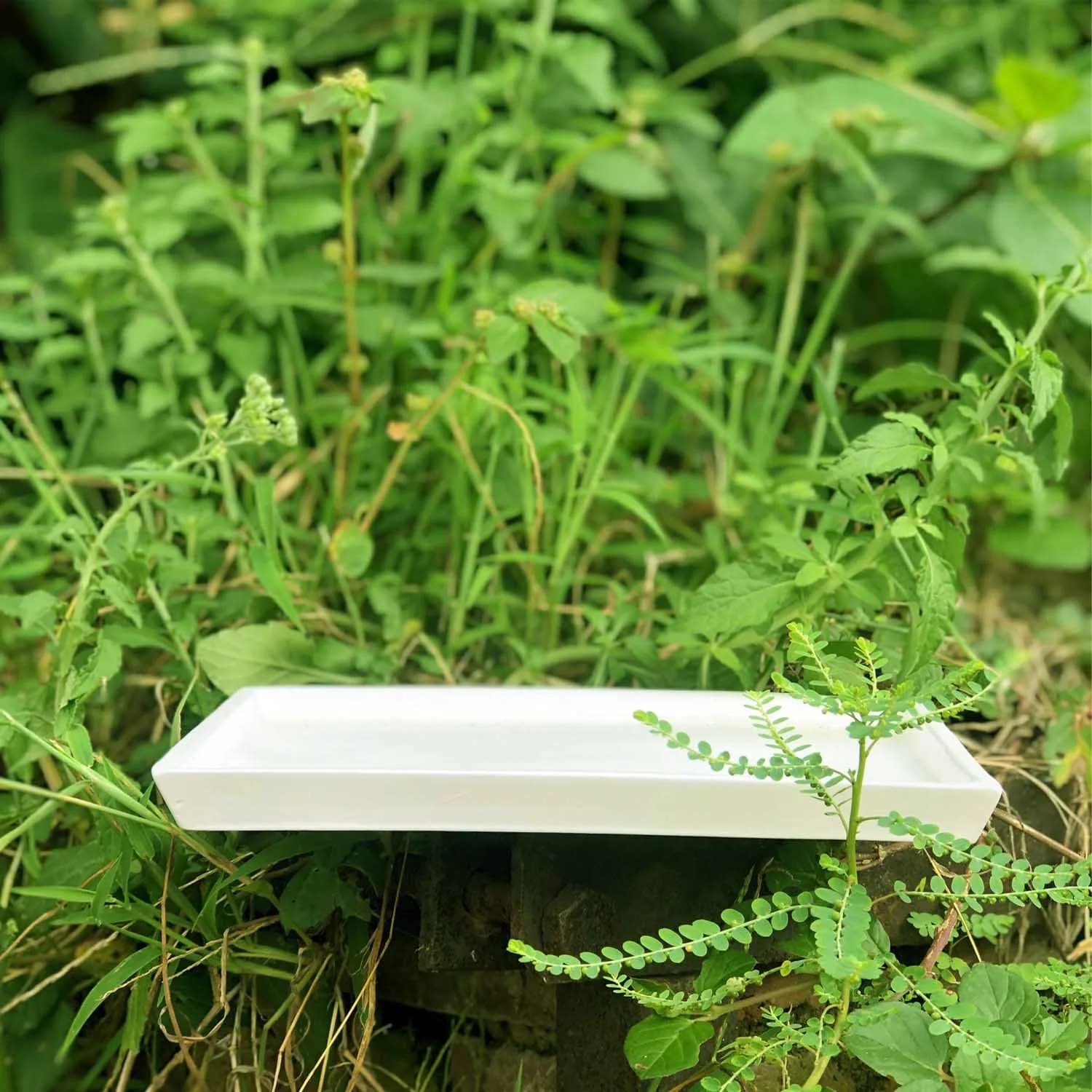
| Long tray | Two or three small pots in a row on a windowsill, desk or counter | Slato tray, about 23.5 × 11.5 × 2.5 cm |
| Rectangular plate | A rectangular pot, or a small cluster | Plate rectangle rec003, about 20 × 14 × 1.5 cm |
| Square plate | A square pot | Plate square collar 4 inch white, about 10 × 10 × 3 cm |
A few practical differences:
- Single plates look tidy and take the least space, but each one needs emptying separately.
- Trays hold several pots, and one tip empties the lot. The catch is that water from one pot can spread under its neighbours, so a tray needs emptying just as regularly.
- Narrow windowsills often suit one long tray better than a row of round plates, because its straight edge sits neatly against the frame.
Browse all the plates for planters and trays by size and colour.


Pots that come with their own plate
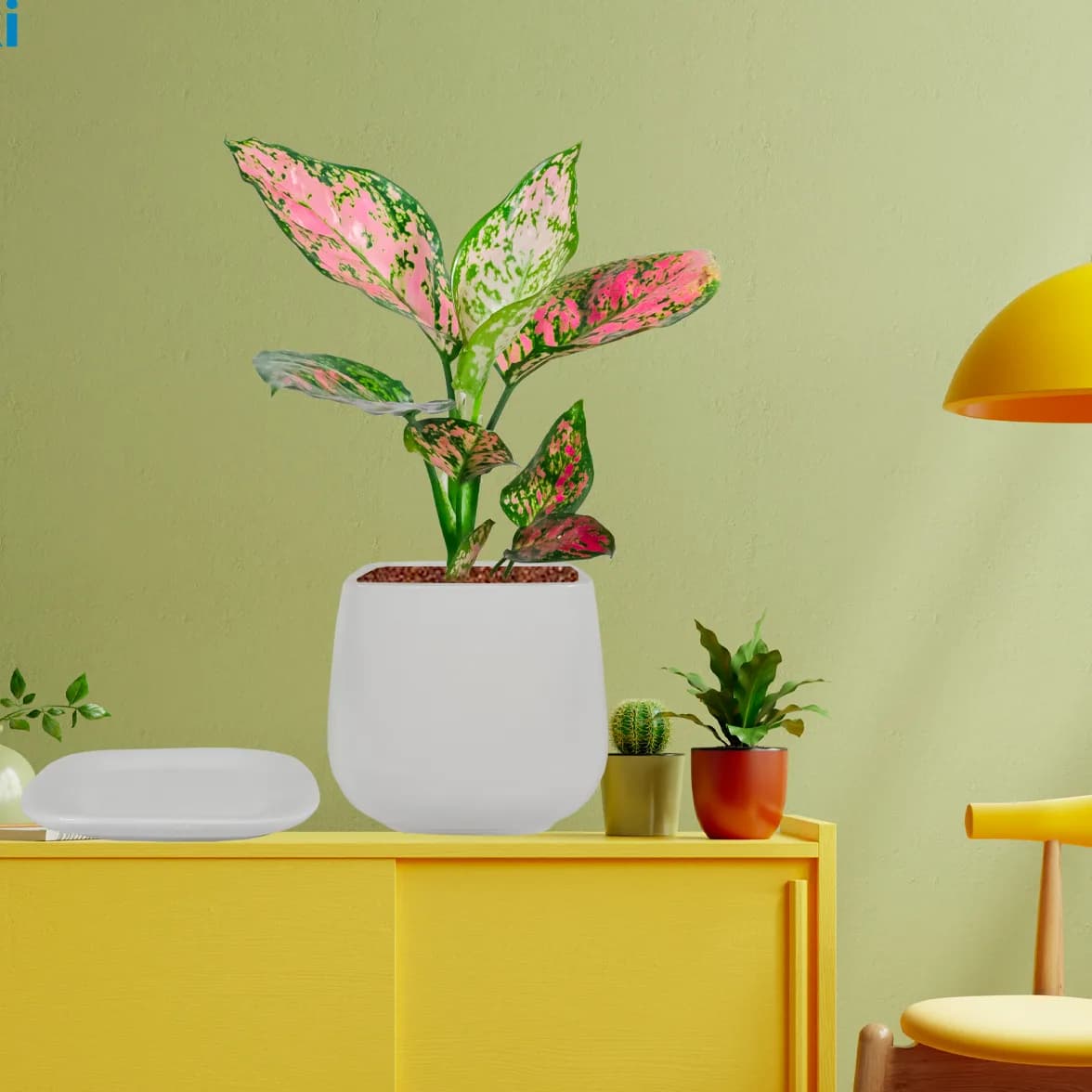
If you'd rather skip the measuring, buy the pot and plate together. Lasaki's Pots with Plate range includes:
- Pearl small white with plate, about 10 × 10 × 9 cm, with a Medium size at about 15 × 15 × 13.5 cm;
- Core with plate white, about 8 cm high and 9.5 cm across.
Both come in many colours besides white. For something smaller, Softsquare 3 inch white with tray (listed under White pots) is about 7.5 cm each way.
With any pot-and-plate set, check one thing: can you lift the plate off to empty it? University of Illinois Extension warns against permanently attached saucers, because emptying the overflow becomes difficult or impossible. The listings don't say whether these plates are separate pieces, so check the product photos or ask us.

Watering from below with a plate or tray
Bottom watering means standing a pot in shallow water and letting the soil draw it up through the drainage hole. It only works if the pot has a hole. CSU Extension notes that watering from the top is generally better than watering from below, so treat this as an occasional method rather than your routine.
- Pour water into the plate or tray, or into a basin for a bigger pot.
- Leave the pot until the surface of the soil feels damp. Bigger pots take longer.
- Lift the pot out, or tip away whatever the soil didn't take up. Don't leave it standing.
- Keep top watering as your usual method: water from the top until water runs out of the hole. CSU Extension also notes that watering only from below can let salts build up in the soil, and watering from the top washes them out.
A plate 1.5 to 2 cm deep holds very little, so for a thorough soak use a deeper tray or a basin.
Styling a group of pots on a tray
A tray is the easiest way to make small pots look intentional, whether on a coffee table, a café counter, a reception desk or a shop shelf.
- Do the arithmetic first. Add up the widths of the pots at their widest point and compare the total with the tray's length, then check each base sits on the flat floor. For example, a single Nebi hp1 pot is listed at about 9.5 × 9.5 cm and the Slato tray at about 23.5 × 11.5 cm, so two Nebi pots take up about 19 cm of the tray's length. Lasaki sells that pairing ready-made as a set.
- Vary the heights. One taller plant beside two low ones holds the eye better than three of the same height.
- Try odd numbers. A group of three often looks more natural than a pair, though a matched pair suits a symmetrical spot such as either side of a door.
- Keep a colour thread. Many colour names, such as Antique, Mint, Truffle, Lily and Saffron, run across Lasaki's pots, plates and trays. Shades can differ between ranges, so compare the product photos or ask us for a close match.
- Leave breathing room. When pots are jammed edge to edge, you can't see whether water is sitting underneath.

Nebi hp1 set of 2 with slato tray white gold
Common mistakes and quick fixes
| Mistake | What happens | Fix |
|---|---|---|
| Never emptying the plate | Soggy soil, struggling roots, mosquito breeding | Tip it out after watering and scrub it weekly |
| Choosing a plate by the pot's rim or inch label | The base perches on the sloping edge, or the plate is the wrong size | Measure the base and compare centimetres |
| Pouring a lot of water at once over a shallow plate | Overflow onto the floor | Water in two smaller rounds, or use a deeper tray |
| Leaving plates under open-air pots in the monsoon | Rain keeps them full | Tip them after rain, or remove them for the season |
| Putting a pot with no hole on a plate | Water collects inside the pot, out of sight | Plant in a plastic nursery pot with holes, set it inside the decorative pot, and lift it out to water |
Illinois Extension's advice for this double-pot set-up matches the plate rule: if water collects in the outer pot, lift the inner pot out and pour away the water in the outer one.
Checklist before you choose
- I have measured the base of the pot, in centimetres.
- The plate's flat floor is a little wider than that base, and the shapes match.
- The rim is deep enough for the amount of water I usually give.
- For a pot sold with a plate, I have checked that the plate lifts off.
- I have a weekly reminder to empty and scrub the plates, especially through the monsoon.
For shops, nurseries, cafés and designers
Many of our plates and trays come in the same colour names as our pots, which makes a coordinated pot and plate easier to offer. If you run a shop, nursery or café, or work as an interior designer, you can request trade access to see trade details, or ask us which plate or tray to pair with a particular pot.
Frequently asked questions
Should a pot plate be bigger than the pot?
It needs to be wider than the pot's base, which is often narrower than the top. Measure the flat bottom of the pot and pick a plate whose flat inner floor is slightly wider, so the pot sits level and drained water has room to spread. A pot rim that overhangs the plate is usually fine, as long as the base sits flat inside; just water gently, because anything that spills over an overhanging rim will miss the plate.
How often should I empty the plate under a plant?
Every time you water, once the pot has stopped dripping. Separately, health agencies such as the CDC advise emptying and scrubbing plant saucers once a week to get rid of any mosquito eggs and larvae. In the monsoon, also check outdoor plates after each spell of rain.
Is there any point putting a plate under a pot with no drainage hole?
Not much: with no hole, the water never reaches the plate and stays around the roots instead. The usual workaround is a "pot inside a pot": keep the plant in a plastic nursery pot that has holes and hide it inside the decorative one. Each time you water, take the inner pot out, let it finish draining, then put it back.
Is a tray better than separate plates?
Neither wins every time. A tray suits a group of small pots you want to move or style together, and a single tip empties it. Separate plates suit single pots and let you water and empty each one on its own schedule.
Do Lasaki pots have drainage holes?
Our product listings don't say whether each pot has a drainage hole, so we can't say for certain here. Look at the photos on the product page, or send us the product name and we'll check.
Can my shop or nursery buy these plates and trays wholesale?
Yes. Lasaki is a wholesale supplier to businesses such as retailers, nurseries, cafés and interior designers. Request trade access on the website to see trade details, or contact us if you want help pairing plates or trays with particular pots.
Products in this guide
Stock Lasaki pots, vases and décor in your store
Retailers, nurseries, cafés and interior designers order from the full Lasaki catalogue with a trade account.
Share this guide
Share on WhatsApp