Bonsai pots explained: shape, depth, colour and drainage
A bonsai pot holds very little soil and frames the whole tree. Learn how rectangular, oval, round and square pots differ, how deep the pot should be for the trunk, which colours suit which trees, and why drainage matters so much.
Lasaki Ceramics team11 min read
Product details checked 28 October 2026

In this guide
Bonsai is usually explained as "planting in a tray": bon means a low-sided pot and sai means planting. So the pot is not an afterthought. It holds the small amount of soil that keeps the tree alive, and it frames the tree the way a mount frames a picture.
This guide covers the main pot shapes and what each one suits, how deep the pot should be for the trunk, how to choose a colour, and why drainage matters more in bonsai than in most pots. Bonsai has many traditions and few fixed rules, so treat this as a starting point and trust your eye.
What makes a bonsai pot different
Three things set a bonsai pot apart from an ordinary planter.
- It is shallow. The RHS (the UK's Royal Horticultural Society) describes bonsai as grown in small, often shallow containers that limit the water and nutrients available to the tree.
- The soil has to drain fast. Brooklyn Botanic Garden notes that a bonsai's roots are very fine and fibrous, and that the soil must drain very quickly to prevent rot.
- It is a finishing pot, not a starting one. Virginia Cooperative Extension, the farming and gardening advice service of two US universities, explains that every bonsai starts in a larger training pot and stays there until it has a good, fibrous root system. A tree dug from the ground and put straight into a shallow bonsai pot has a poor chance of surviving.
The trade-off: a shallow pot holds little water and dries out quickly, so a bonsai needs checking every day.
Pot shapes and what they suit
Traditional bonsai pots are round, oval, square, rectangular or hexagonal, and each shape changes how the tree looks. These are general tendencies in bonsai practice, not rules:
| Shape | The look it gives | Often chosen for |
|---|---|---|
| Rectangular | Formal and strong, with straight sides | Heavy trunks, pines and other evergreens, large upright trees |
| Oval | Softer, with curved sides | A wide range of trees; one well-known bonsai teacher calls it the most versatile shape |
| Round | Lets the eye follow the trunk | Trunks with a lot of movement; deep round pots for cascades (trees that bend down over the rim) and for young trees in training |
| Square or hexagonal | Equal on all sides, compact | Tall, slender literati-style trees (a thin trunk with few branches); deeper versions for cascades |
| Long, shallow tray | Suggests a stretch of open land | A scene with the tree set to one side |
Two placement conventions go with the shape. With a rectangular pot, one of the long sides is the front. And the base of the trunk usually sits slightly off-centre, on the side away from most of the branches, which keeps the asymmetrical balance that bonsai design is built on.
Shapes in the Lasaki bonsai range
Here is how our bonsai pots are named and sized. All sizes are approximate outside measurements.
- Rectangles: Rectangle white rec002 is 26 × 18.5 cm and 7 cm high; the smaller Rectangle white rec003 is 19.5 × 12.5 cm and 6 cm high. Rectangle oblong big white is longer and narrower, at 31 × 17.5 cm and 6.5 cm high.
- Round (listed by diameter): Camry medium white is 23 cm across and 7.5 cm high, Camry big white 30 cm across and 10 cm high, and Twist small multi 16.5 cm across and 6.5 cm high.
- Squares: Square downey small white is 20 × 20 cm and Square downey big white 24 × 24 cm, both 7 cm high: shallow squares, not deep cascade pots.
- Oval: no pot in the range is named oval. Some designs, such as Flora multi (45.5 × 31.5 cm and 11 cm high), are listed by length and width rather than diameter, so the outline could be oval or rectangular: check the photos or ask us.


How deep should the pot be?
Depth does two jobs: it gives the roots room, and it balances the look of the trunk.
- Heavy trunk, deeper pot. Bonsai teacher William Valavanis writes that heavier trunks belong in deeper containers for visual balance, while thin, delicate trunks look good in shallow ones. The US National Bonsai Foundation describes a thick-trunked pine that looked too heavy for its shallow rectangular pot; a deeper pot fixed the look and gave the roots more room.
- Cascade and flowering trees, deeper pots. Virginia Cooperative Extension notes that pots for cascade, semi-cascade and flowering bonsai are deeper than others. A full cascade falls below the base of the pot, so the tree is displayed on a stand.
- Sides and feet. Straight edges and short, sturdy feet make a pot look strong enough to carry a big, powerful tree. Curved sides suit a softer, curving trunk.
Most of our bonsai pots are low: of the 28 designs and sizes that list a height, 18 are 10 cm high or less (70 of the 80 listings, if each colour counts separately). The deepest is Rootsphere multi, about 38 × 18 cm and 17.5 cm high. Creston big white, about 35 × 23 cm and 12.5 cm high, is a middle option: deeper than most, but well short of Rootsphere.

Getting the size right
There is no single formula, but a quick visual check helps. For upright trees, Valavanis's own method is that the tree's height should roughly equal the pot's length plus its depth, judged by eye. He also points out that a bonsai tends to look larger in a smaller pot.
Here is how it works out for three of our pots, using the outside height as the depth:
| Pot | Length or diameter (cm, approx.) | Height (cm, approx.) | Length + height (cm) |
|---|---|---|---|
| Rectangle white rec003 | 19.5 | 6 | 25.5 |
| Rectangle white rec002 | 26 | 7 | 33 |
| Camry big white | 30 | 10 | 40 |
By that yardstick, rec002's outside size (about 26 cm long and 7 cm high) points to an upright tree of roughly 33 cm. Treat it as a first check only.
Whatever the yardstick says, the roots must fit. Measure the root pad, the flat mass of roots and soil, and leave room for fresh soil around it. A pot is smaller inside than its outside measurements, and our listings don't give the inside depth or say whether the height includes feet. If the fit looks tight, ask us.
Choosing a colour
Colour is a matter of taste, but most guidance agrees on one idea: the pot should complement the tree, not compete with it.
- Quiet, earthy pots for evergreens. Unglazed browns, reds, greys and tans are the traditional choice for pines, junipers and other evergreens.
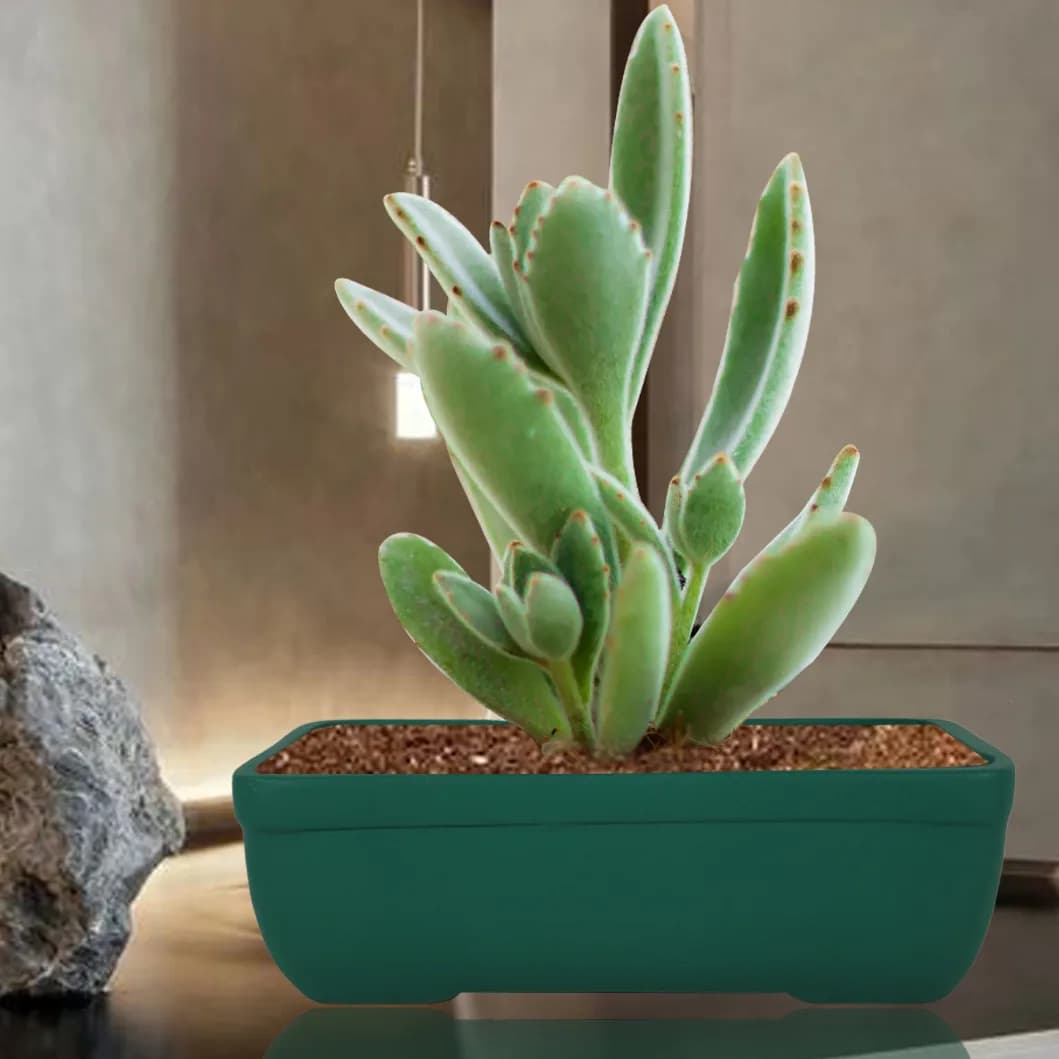
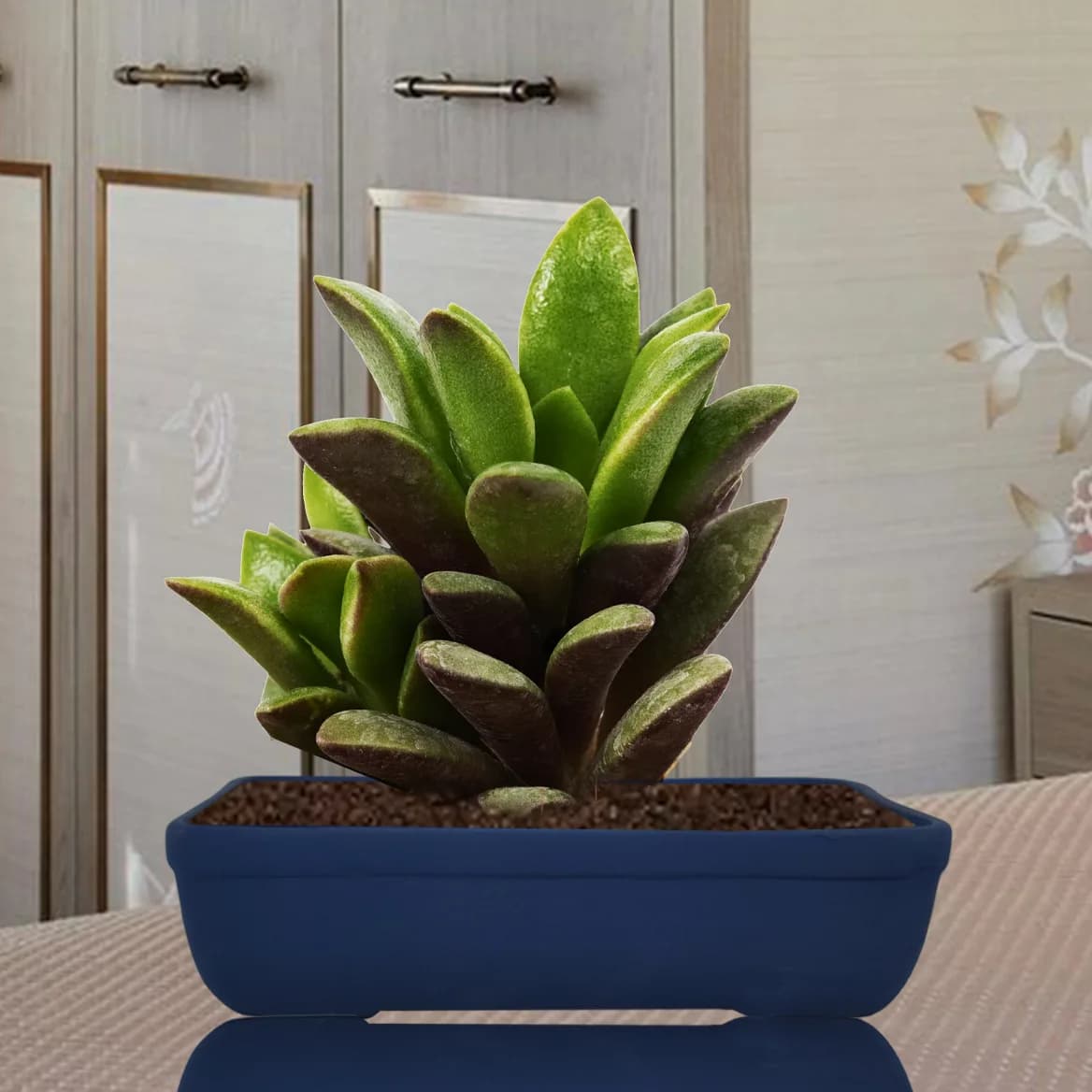
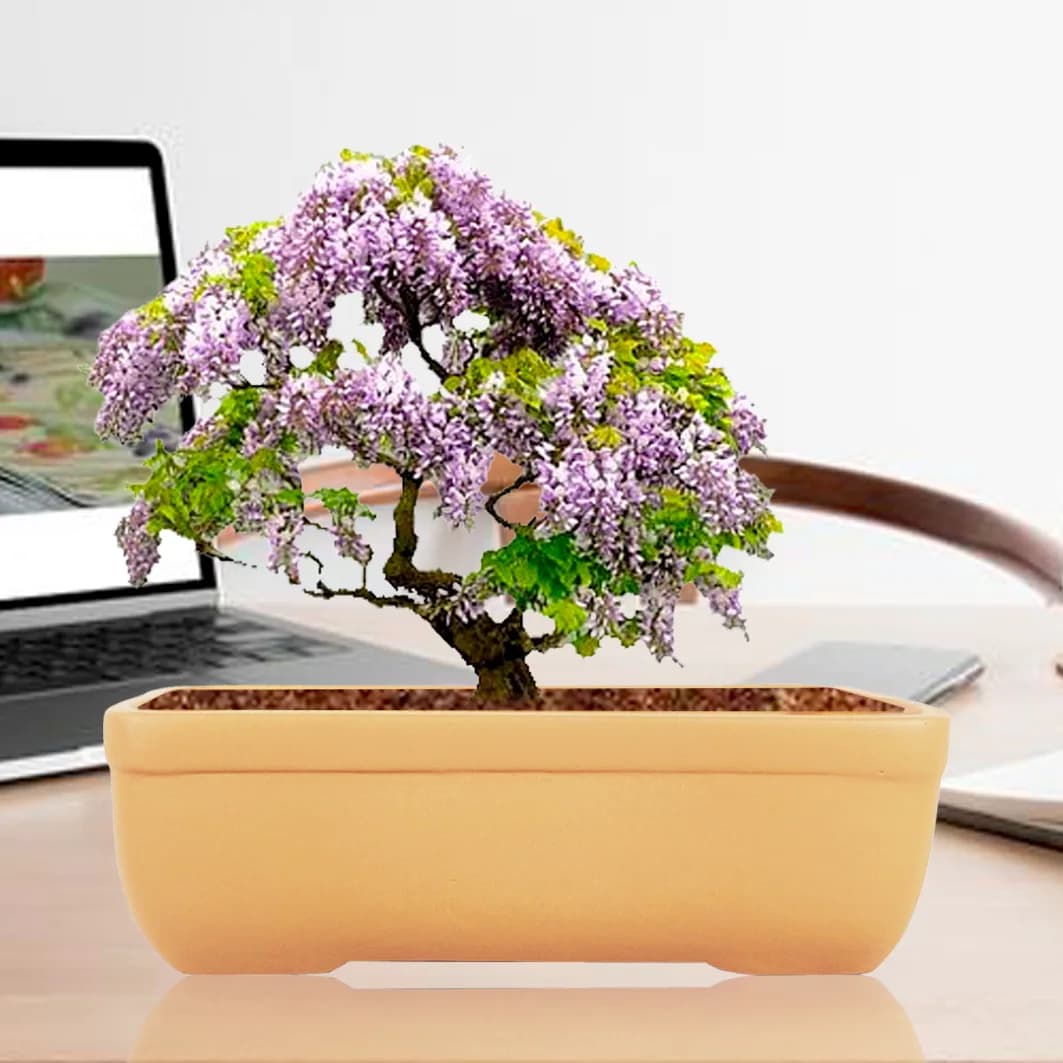
- Colour for flowers, fruit and autumn leaves. Glazed, coloured pots are often paired with flowering and deciduous trees, in a shade that echoes the blossoms or contrasts with the leaves. Chicago Botanic Garden chose the pot for one of its bougainvilleas to make the blooms stand out; the same works for a bougainvillea on an Indian balcony.
- Bright colour has a downside. A strong colour that sets off autumn leaves can overwhelm the bare tree once they fall. Painted patterns tend to suit small bonsai, where they don't take over.
- White gives a clean, modern look that suits cafés and contemporary interiors. That is a style choice rather than a tradition; our white bonsai pots are also listed under white pots.
Rectangle rec002 comes in 15 colours, including White, Antique, Deep Jungle, Ginger, Blue, Black Gold and Multi. The round Camry range has 14 colours in Medium, and 11 of them are also listed in Big. Judge the shade from the photos, not the name. The listings also don't say which pieces are glazed or unglazed; ask us if that matters.
Why drainage matters so much in bonsai
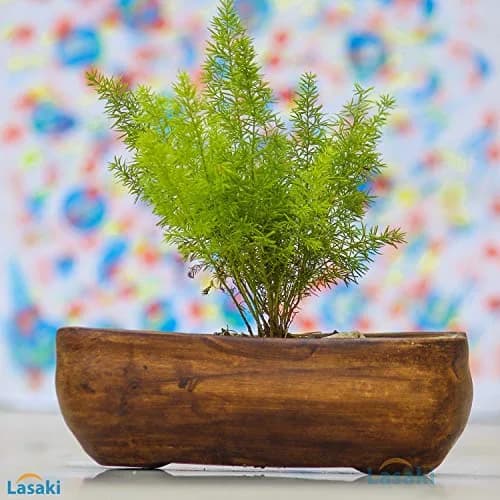
A bonsai pot has almost no margin for error: a thin layer of soil, fine roots, and a mix meant to let water run straight through. If the water has nowhere to go, it collects at the bottom, and roots left in waterlogged soil can rot. Virginia Cooperative Extension warns, in its advice on cool-season care, that more bonsai are killed by overwatering than by drying out. In the hot, dry months before the monsoon, the bigger risk is a pot that dries out, so check the soil every day.
That is why traditional bonsai pots have large drainage holes. Growers cover each hole from the inside with a piece of mesh, so the coarse soil stays in while the water runs out.
How this plays out through the Indian year:
- Summer: shallow pots dry out fast in warm, windy weather, and the RHS says summer watering can be needed once or twice a day. On a north Indian balcony when the hot loo wind is blowing, check the soil morning and evening.
- Monsoon: rain and humid air keep the soil wet for longer, so this is when drainage matters most. Feel the soil before you water, and never leave the pot standing in water.
- Cooler months: most trees grow more slowly and need water less often.
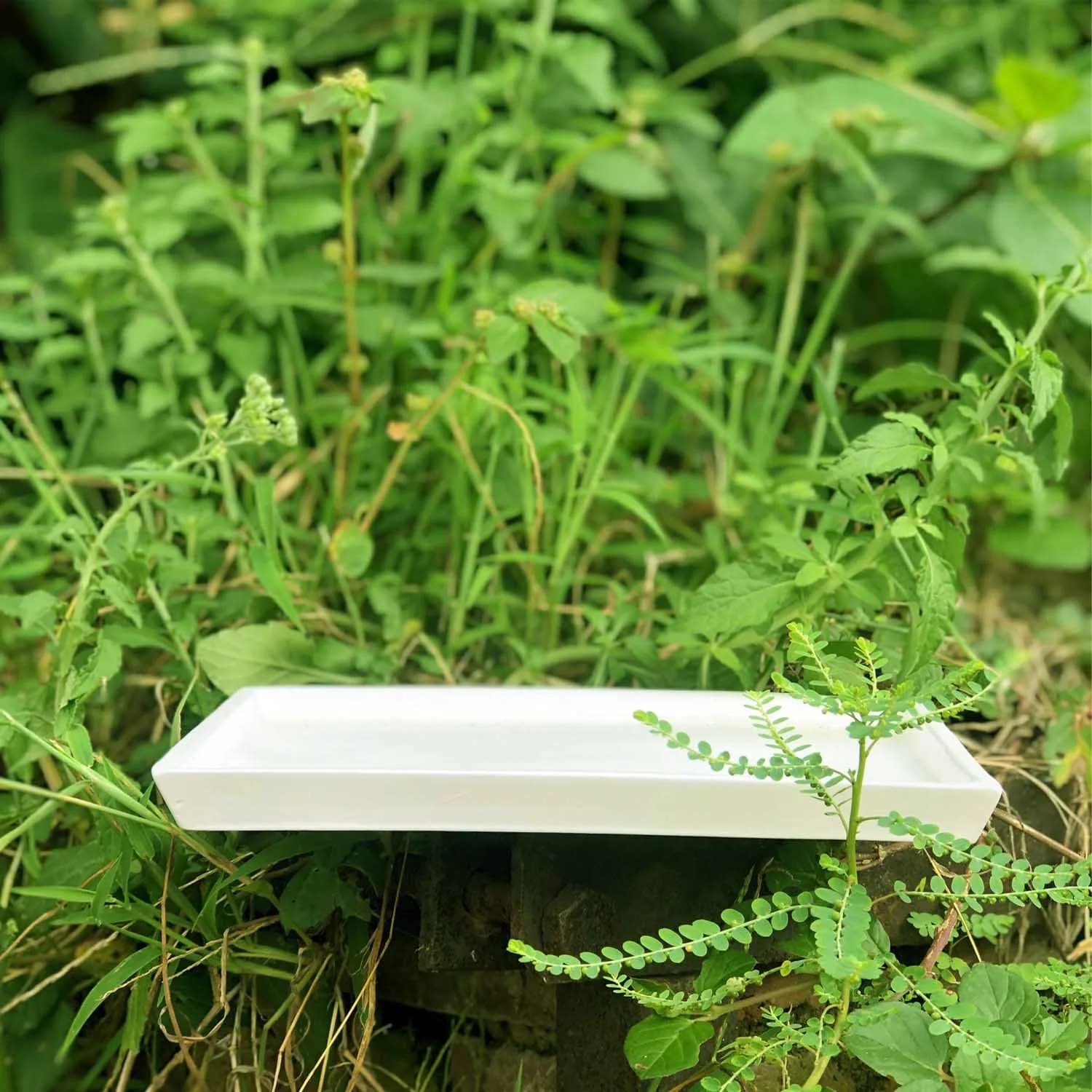
Indoors, a plate under the pot catches the run-off; tip it out once the pot has drained. Outdoors, Virginia Cooperative Extension suggests a slatted stand to keep drainage at its best. For a smaller rectangle, Plate rectangle white rec003 is about 20 × 14 cm and 1.5 cm high, a little larger than Rectangle rec003 (19.5 × 12.5 cm). Plates aren't listed against particular pots, so measure your pot's base before choosing from the plates for planters.
Matching a pot to your tree, step by step
- Find the front: the side from which the trunk looks best.
- Measure the tree's height, the spread of its branches, the trunk's thickness near the base, and the root pad.
- Pick the shape with the trunk and style in mind: straight and powerful, curving and delicate, or cascading.
- Pick the depth: heavier trunk, deeper pot. A tree that is still developing stays in its training pot for now.
- Check the size by the cm figures for length, width (or diameter) and height, not the size name: Small, Medium and Big only compare sizes within one design. Then apply the length-plus-depth check and make sure the root pad fits.
- Study the photos for the outline and, where shown, the base. Pick a colour that supports the leaves, flowers or bark, confirm the drainage holes before planting (ask us if you can't see them), and decide whether you want a plate.
Common mistakes and how to fix them
| Mistake | What goes wrong | Fix |
|---|---|---|
| A nursery plant goes straight into a very shallow pot | Too little soil for roots that are not ready | Grow it on in a larger training pot first |
| A thick trunk in a thin, shallow pot | The tree looks top-heavy and the roots are cramped | Move it to a deeper, sturdier pot |
| A bright, busy pot under a tree full of flowers | The pot competes with the blooms | Choose one colour that echoes or contrasts with the flowers |
| The trunk planted dead centre | The asymmetrical balance of the design is lost | Set the trunk slightly off-centre, away from the heavier branches |
| Watering by the calendar | Dry roots in the pre-monsoon heat, soggy roots in the rains | Check the soil every day and keep it just moist, never soggy |
Bonsai pots for nurseries, shops, cafés and designers
Choosing a bonsai pot comes down to three questions: which shape, how deep, what colour. If you sell trees, keep a short list of each pot's measurements in cm beside them, so you can match a pot to a customer's tree on the spot.
Retailers, nurseries, cafés and interior designers can request trade access to order from the Lasaki catalogue. For anything a listing doesn't answer, such as drainage holes, glaze or inside depth, ask us.

Frequently asked questions
Do bonsai pots need drainage holes?
Yes. In bonsai they are treated as essential. A bonsai grows in a thin layer of fast-draining soil, and water has to leave the pot quickly or the fine roots can rot. Traditional bonsai pots have large holes, covered inside with mesh so the soil stays put. Our listings don't say which Lasaki pots have holes, so check the photos or ask us about the pot you have in mind before planting into it.
How deep should a bonsai pot be?
There is no single right depth; it depends on the tree. Thick, heavy trunks usually look better, and have more root room, in a deeper pot; slender trunks suit shallow pots; and cascade and flowering trees are generally given deeper pots. A young tree still building its trunk and roots does best in a larger, deeper training pot. In our range, most bonsai pots stand no taller than 10 cm, and Rootsphere multi is the deepest, at about 17.5 cm.
Can I keep a bonsai indoors in a flat?
Some can. Bonsai of temperate trees such as pines and maples are grown outdoors and brought in only for short spells. Indoor bonsai are usually tropical or subtropical trees, and Virginia Cooperative Extension's list of them includes trees familiar in India such as ficus, gulmohar, kachnar, dwarf pomegranate (anaar) and hibiscus (gudhal). In much of India these warm-climate trees can also be kept outdoors in a bright, sunny spot, sheltered on cold winter nights in the north; if yours lives indoors, give it the brightest place you have and check the soil often.
When should I repot my bonsai?
At the right time of year for that tree, not simply when the new pot arrives. The RHS advises repotting and root pruning in spring, ideally before new growth starts, and says most trees need it every two or three years: slow growers less often, fast growers more often. Seasons vary across India, so ask the nursery that supplied the tree about your species.
Is a white pot a good choice for a bonsai?
It can be. White is a modern choice rather than a traditional one, and it lets the green of the leaves stand out. Traditional guidance favours a pot that complements the tree: quiet, earthy tones for evergreens, and colour for flowering or fruiting trees. Our white bonsai pots include Rectangle rec002 and rec003, Rectangle oblong, Camry, Square downey and Creston; compare the photos with your tree's bark and leaves.
Products in this guide


Stock Lasaki pots, vases and décor in your store
Retailers, nurseries, cafés and interior designers order from the full Lasaki catalogue with a trade account.
Share this guide
Share on WhatsApp