Easy indoor plants for Indian homes: 9 forgiving plants and the pots that suit them
Money plant, snake plant, ZZ, peace lily and five more forgiving houseplants: the light and water each one needs, which are toxic to cats and dogs, how watering changes in the monsoon and winter, and the kind of pot that suits each plant.
Lasaki Ceramics team13 min read
Product details checked 28 October 2026
In this guide
- First, read the light in your home
- The nine plants at a glance
- Nine easy indoor plants
- Big plants need big, steady pots
- Watering: the habit that matters most
- Choosing the pot: four rules
- Pets and small children
- A myth worth dropping: "air-purifying" plants
- Common mistakes and quick fixes
- Quick checklist
- For nurseries, shops, cafés and designers
The nine plants in this guide are easy because they cope with the indirect light inside a typical flat, forgive the odd late watering, and show you clearly, with drooping or yellowing leaves, when something is wrong. What kills them most often is too much water.
Lasaki makes ceramic pots, so buy the plants themselves from a nursery you trust.
First, read the light in your home
Plant labels talk about bright, medium and low light. In a flat, that roughly means:
- Bright indirect light: near a window, but out of the patch of sun on the floor. Most plants here do best there.
- Medium light: a few feet back from a bright window, or by one that gets only gentle morning sun.
- Low light: deeper into the room. "Tolerates low light" means the plant survives there, usually growing slowly.
US university gardening advisory services (known as extension services) put the brightest spots near west- and south-facing windows. In an Indian summer, hot afternoon sun through glass can bleach or scorch leaves, so add a sheer curtain or move the plant back. Light shifts with the seasons, so recheck the spot after a few months.
The nine plants at a glance
| Plant | Light | When to water | Cats and dogs |
|---|---|---|---|
| Money plant (pothos) | Bright indirect; copes with low | When the soil is nearly dry | Toxic |
| Snake plant | Bright to low; no midday summer sun | Only when dry; far less in winter | Toxic |
| ZZ plant | Bright indirect to low | Only when completely dry | Toxic |
| Peace lily | Bright indirect; no direct sun | When the top few cm are dry | Toxic |
| Spider plant | Bright indirect | Keep lightly moist | Non-toxic |
| Rubber plant | Bright indirect; no afternoon sun | When the top has dried slightly | Can be harmful |
| Aglaonema | Indirect; good in low light | Moist in warm months, less in winter | Toxic |
| Areca palm | Bright indirect | Moist, never soggy | Non-toxic |
| Syngonium | Bright indirect; no direct sun | Freely while growing, less in winter | Toxic |
Nine easy indoor plants
1. Money plant (pothos)
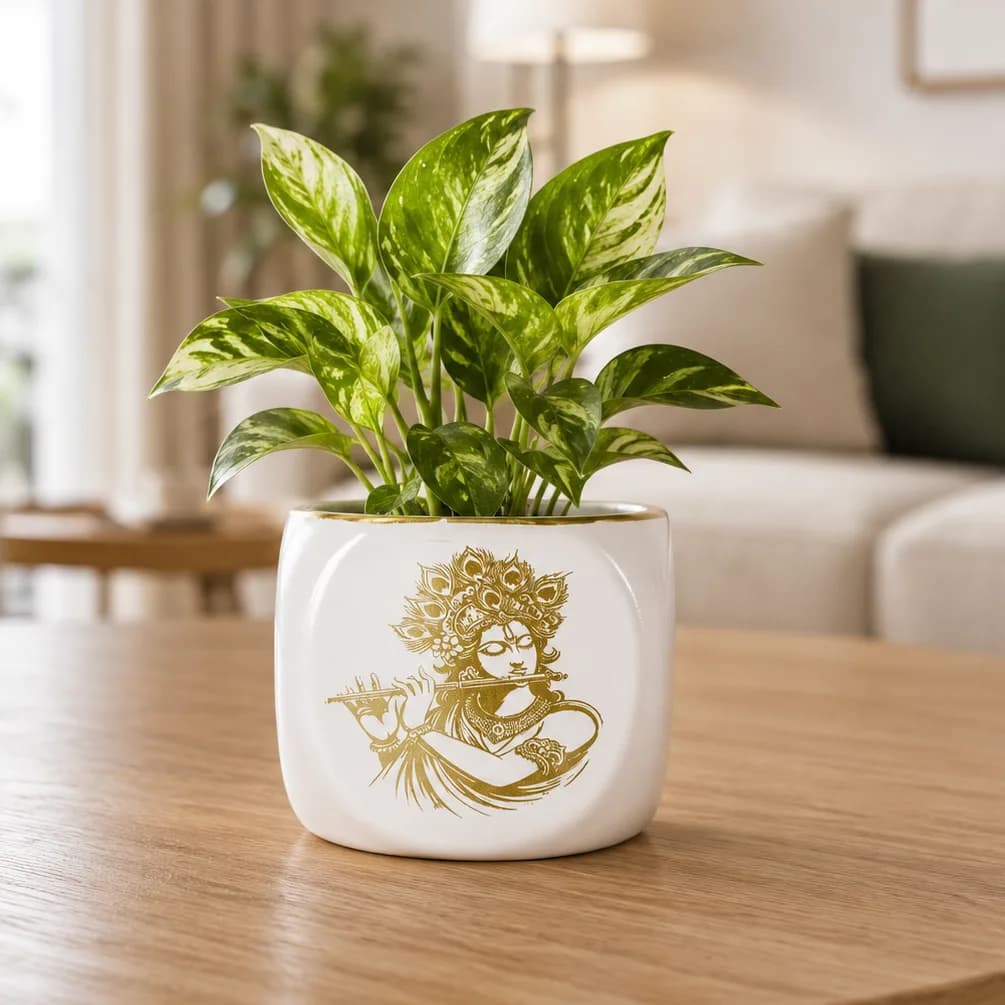
In most Indian homes, "money plant" means pothos (Epipremnum aureum), the trailing vine with heart-shaped leaves, plain green or splashed with yellow. The jade plant, a sun-loving succulent, is also sold as "money plant", so check the botanical name on the label.
- Light: bright, indirect light is best. It survives in low light, but variegated leaves can fade to plain green there, and direct summer sun can scorch them.
- Water: when the potting mix (soil) is close to dry. Soggy soil rots the roots.
- Good to know: stem cuttings root easily in water, which is why so many homes grow it in a bottle. Wear gloves when pruning, as the plant can irritate skin.
- Pot: let it trail from a wall pot or from a tall pot on a shelf.
All sizes and weights in this guide are as listed on our product pages. Cloy big wall hanging measures about L 7 × W 10 × H 26 cm; check the photos to see how it hangs. For a shelf, Dristika 7.5 inch white, about 19 cm high and 13 cm across, lets the vines fall clear of the edge.

2. Snake plant (sansevieria)
Nurseries still sell it as sansevieria, though botanists now call it Dracaena trifasciata. Its leaves are stiff and upright.
- Light: a bright, lightly shaded spot is ideal, but most cope with lower light. Keep it out of midday summer sun.
- Water: only when the soil is dry; check with a finger rather than watering on a fixed day. NC State Extension suggests once every one to two months in a cool winter; in a warm south Indian winter, go by the finger test. It likes dry air, so skip the misting.
- Pot: a snug pot with good drainage. As the plant is tall and can topple, growers often choose one slightly wider, with a broad, stable base.
Pi pot ex-large white is about 20 cm high and 23 cm across; Orb rustic is about 20 cm high and 25 cm across, with a listed weight of about 2.45 kg. Match the width to the root ball rather than buying the biggest pot. Neither listing says whether the pot has a drainage hole, so check the photos or ask us, or use it as a cover pot (see the pot rules below).
3. ZZ plant
The ZZ plant (Zamioculcas zamiifolia) grows from thick rhizomes that store water, which is why it copes so well with a missed watering.
- Light: it survives low light, but bright, indirect light speeds up its slow growth. Direct sun can scald the leaves.
- Water: Clemson Extension suggests once or twice a month, only after the soil has dried out completely. Soggy soil is the one thing it will not put up with.
- Pot: the same snug, well-drained pot as a snake plant.
4. Peace lily
The peace lily (Spathiphyllum), with glossy leaves and white sail-like flowers, is quick to show when it is thirsty.
- Light: bright, indirect light, out of direct summer sun and cold draughts (an AC blowing straight at it counts).
- Water: when the top few centimetres have dried. A thirsty peace lily droops alarmingly but usually recovers soon after watering. Soil that stays wet causes root rot, so check it before answering every droop with water.
- Good to know: the RHS (the UK's Royal Horticultural Society) notes that fluoride in tap water can damage the leaves and dry air browns the edges. Filtered water helps, as does a tray of damp gravel under the pot, with the pot above the water line; empty and scrub the tray at least once a week.
Pearl medium white with plate comes with its own plate and is listed as about 15 × 15 cm and 13.5 cm high; there are more pots with plate too. Its listing does not say whether it has a drainage hole, so check the photos or ask us; without one, use it as a cover pot with the nursery pot inside.
5. Spider plant
The spider plant (Chlorophytum comosum) grows arching, often striped leaves, and once it is at least a year old usually sends out long stems with baby plants at the tips.
- Light: bright but indirect. Strong sun can yellow or brown the leaves.
- Water: keep the soil lightly moist and empty the plate. Brown tips can come from fluoride in tap water, as well as from over- or underwatering.
- Pot: do not over-pot it; an overly large pot can discourage flowering (the baby plants form on the flowering stems). It looks best where the leaves can cascade, such as a taller pot on a shelf: Spanish pineapple big white is about 21.5 cm high and 18.5 cm across. Its listing does not say whether it has a drainage hole, so check the photos or ask us, or use it as a cover pot.
6. Rubber plant
The rubber plant (Ficus elastica) has large, glossy leaves; indoors it is usually kept to 2 to 10 feet (about 0.6 to 3 m) with pruning and support.
- Light: bright, indirect light, protected from afternoon sun.
- Water: regularly in the warm months, letting the soil dry slightly in between; in winter, keep it only just moist.
- Leaf drop: sudden leaf drop is usually overwatering, though cold draughts, low light and a fall in temperature can also cause it. A few yellowing lower leaves are normal.
- Handling: wear gloves when pruning; the sticky white sap can irritate skin.
7. Aglaonema (Chinese evergreen)
Aglaonema is grown for its leaves and suits a spot away from the window.
- Light: diffuse sun or good indirect light. NC State Extension calls it an excellent plant for low-light indoor spots.
- Water: keep the soil moist in the warm growing months, less so in winter, and let it dry a little between waterings to prevent root rot.
- Cold: it does not tolerate cold, so on north Indian winter nights move it away from cold glass.
- Pot: a tabletop pot only a little wider than the root ball, such as Orin 6d white, about 13.5 cm high and 15.5 cm across.
8. Areca palm
The areca palm (Chrysalidocarpus lutescens, still often labelled Dypsis lutescens) is a feathery palm that, according to Clemson Extension, grows 6 to 7 feet (about 2 m) tall indoors.
- Light: bright, indirect light near an east-, west- or south-facing window.
- Water: moist but never soggy. Water thoroughly when the surface dries.
- Watch for: spider mites, which it is very prone to. Check under the leaves regularly.
- Pot: palms like slightly confined roots; repot every two to three years, only if roots fill the pot.
9. Syngonium (arrowhead plant)
Syngonium (Syngonium podophyllum) has arrow-shaped young leaves, plain green or marked with silver or pink, and slowly turns into a climber as it ages.
- Light: bright, indirect light; variegated types like it bright but filtered. Direct sun can burn or bleach the leaves.
- Water: freely while it is growing, more sparingly in winter.
- Cold: the RHS gives a minimum winter temperature of 15°C, so keep it away from cold windows in a north Indian winter.
- Pot: a medium tabletop pot. To keep it bushy, cut off long climbing stems as they appear, wearing gloves: the plant can irritate skin and eyes.
Big plants need big, steady pots
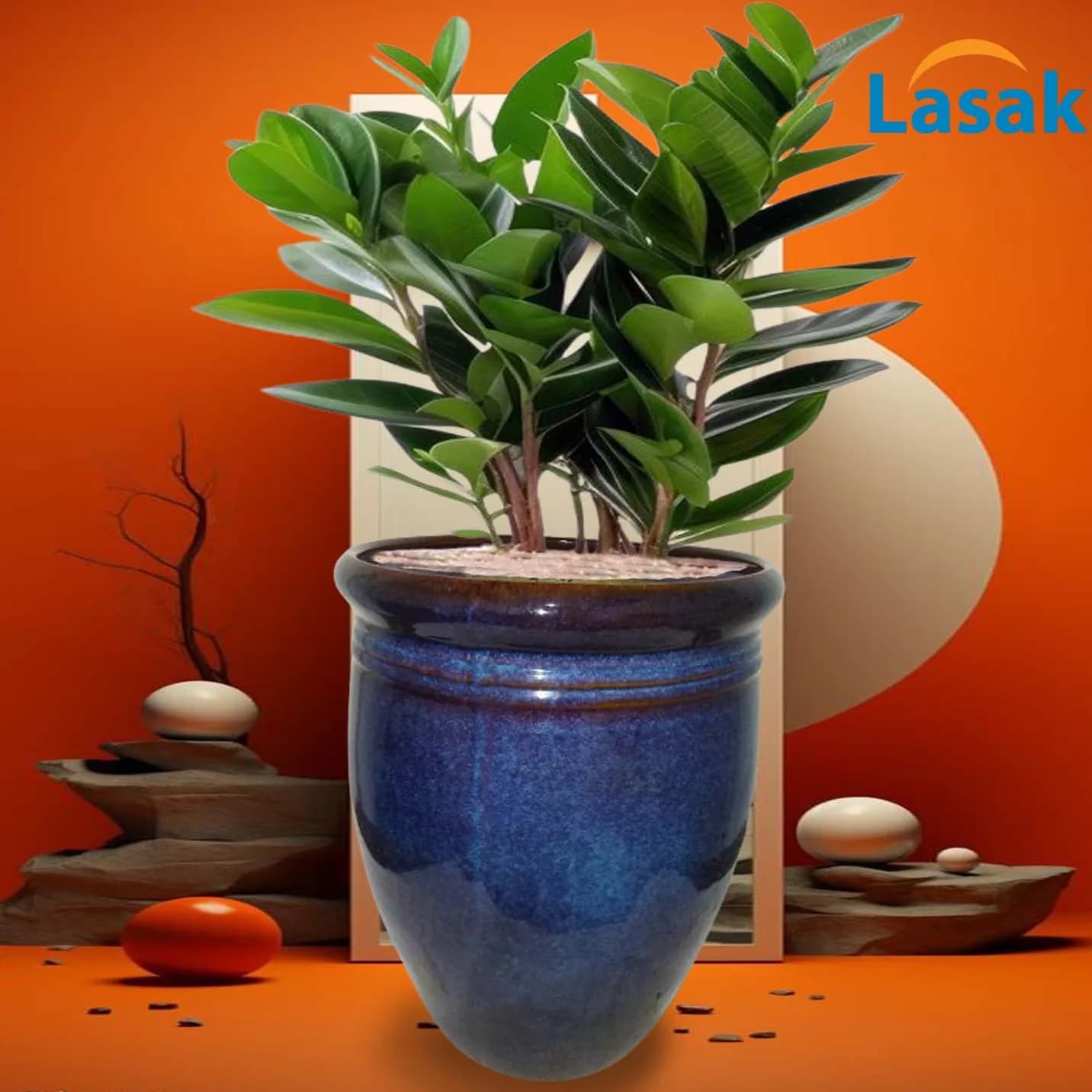
Rubber plants and areca palms grow into floor plants. At each repotting, choose a pot broad enough to stay steady but only a little larger than the root ball, such as Opal multi, about 38 cm high and 37 cm across, or Bloom multi, about 44 cm high and 32 cm across. Their listings give no weight and do not say whether they have a drainage hole, so check the photos or ask us; without a hole, use the pot as a cover pot.

Watering: the habit that matters most
Overwatering kills more potted plants than anything else, according to Clemson Extension. Roots need air as well as water.
- Check first. Push a finger into the soil up to the first joint. If it is dry at the fingertip, most of these plants are ready for water; ZZ and snake plant can wait until it is dry further down.
- Water thoroughly, until water runs out of the bottom of the pot.
- Empty the plate. Never leave the pot standing in the run-off, and tip out any water inside a cover pot.
- Adjust with the season. Plants in warm, sunny spots need water more often than those in cool, dim ones. In the humid monsoon the soil dries slowly, so waterings usually get further apart; most of these plants need less in winter too.
Choosing the pot: four rules
- Drainage first. Plant straight into a pot only if water can drain out of it. Our product details do not record which Lasaki pots have a drainage hole, so check the product photos or ask us before planting directly.
- Or use it as a cover pot. Leave the plant in its plastic nursery pot, which has holes, and stand that inside the ceramic pot. Tip away any water that collects at the bottom.
- One size up. Go only a few centimetres wider than the root ball. Soil the roots cannot reach stays wet for a long time.
- Something underneath. A plate catches drips and protects floors. The round plates for planters in our range go up to about 16 cm across, such as Plate circular 6 inch white R6. Measure the base of your pot first; if it is wider than that, ask us.
For a matching look across several plants, the white pots are an easy place to start.
Pets and small children
The labels in the table follow the ASPCA, a US animal-welfare organisation that runs a pet poison helpline, except for the ZZ plant (medium toxicity) and the rubber plant, which follow NC State Extension. The RHS also advises keeping peace lilies, snake plants and pothos away from children.
If your cat or dog chews leaves, start with a spider plant or an areca palm. Keep the others truly out of reach, and remember that cats climb and jump and that trailing stems hang down from shelves and wall pots. If a pet or a child does chew a plant, call your vet or doctor straight away, and keep the plant's name handy.
A myth worth dropping: "air-purifying" plants
Many of these plants are sold as air purifiers, but a 2019 Drexel University review of 30 years of research concluded that potted plants do not noticeably improve the air in a home. Grow them because they are a pleasure to look after, and open a window for fresh air.
Common mistakes and quick fixes
| Mistake | What you see | Fix |
|---|---|---|
| Watering on a fixed day | Yellow leaves, soil that never dries | Check with a finger first |
| Leaving water in the plate | Wet soil, rot at the base | Empty the plate after watering |
| Hot afternoon sun through glass | Bleached or scorched patches | Move it back or add a sheer curtain |
| A cold window in winter | Dropped or damaged leaves | Move it away from the glass at night |
Quick checklist
- Choose plants for the light you have, and pet-safe ones if a cat or dog chews leaves.
- Check the soil with a finger before watering; water less in the monsoon and in winter.
- Never leave water standing in plates or cover pots; empty and scrub gravel trays and money plant bottles at least once a week.
- Repot only when roots fill the pot, going a few cm wider each time.
- Wipe dust off smooth leaves with a soft, damp cloth now and then.
For nurseries, shops, cafés and designers
Buying pots in quantity? Measure the nursery pots your plants arrive in and match them to the cm figures on our product pages. Businesses can request trade access to the Lasaki catalogue, and for anything our product pages do not answer, such as drainage holes or weights, ask us.
Frequently asked questions
Which indoor plant is easiest for a complete beginner?
For a room without much sun, the snake plant and the ZZ plant are hard to beat: both store water and prefer to dry out between waterings. Money plant (pothos) is just as forgiving and grows faster. Beginners usually lose these plants by watering too often, so feel the soil before you reach for the watering can.
Is money plant safe for cats and dogs?
No. The ASPCA lists pothos, the plant most Indian homes call money plant, as toxic to cats and dogs, and chewing it can cause mouth irritation, drooling and vomiting. If your pet chews leaves, the spider plant and the areca palm are on the ASPCA's non-toxic list.
How often should I water indoor plants during the monsoon?
There is no fixed number of days. Humid air slows drying, so most plants need water less often than in summer. Test the soil with a finger up to the first joint, water only when it is dry at the fingertip, and tip out whatever collects in the plate so that mosquitoes cannot breed in it.
Can money plant grow in water instead of soil?
Pothos stem cuttings root easily in water, which is why money plant is so often kept in a bottle or jar in a bright spot. Change the water and scrub the bottle at least once a week so mosquitoes cannot breed in it. The RHS suggests potting the cutting up into well-drained potting soil once roots appear; Clemson Extension adds that the container should have a drainage hole.
Do Lasaki pots have drainage holes?
Our product details do not record whether a pot has a drainage hole, so please check the product photos or ask us about the pot you have in mind. A pot without a hole can still work as a cover pot, with the plant kept inside it in its plastic nursery pot.
Do indoor plants really clean the air?
Not in a way you would notice at home. The 2019 Drexel University review covered a dozen studies in which plants were tested in small sealed chambers, and estimated that matching a couple of open windows would take 10 to 1,000 plants per square metre of floor.
Products in this guide

Guides in this series
Stock Lasaki pots, vases and décor in your store
Retailers, nurseries, cafés and interior designers order from the full Lasaki catalogue with a trade account.
Share this guide
Share on WhatsApp